
Market Share of Headless CMS
Distribution of headless CMS usage in France 1.
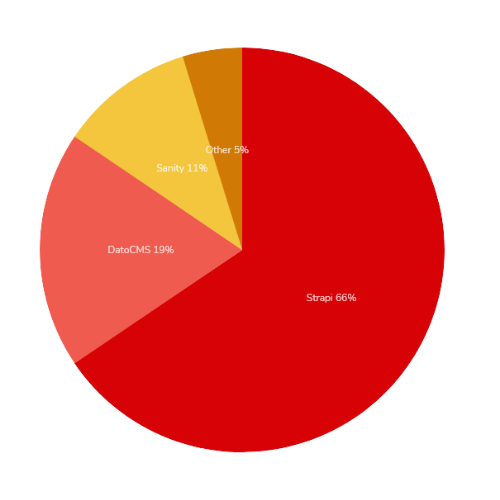
As of November 16, 2021, the BuiltWith website counts 575 websites in France using headless technology.
1. Headless CMS: A New Trend
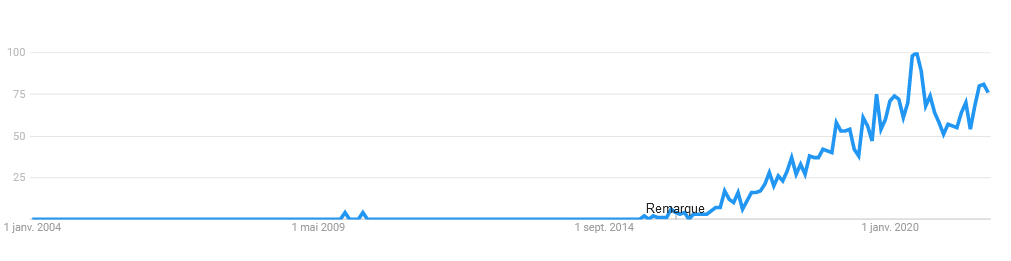
Unlike the other types of CMS, headless CMS is relatively recent. However, it is gaining more and more popularity, as indicated by the following graph (number of Google searches for the term "Headless CMS" worldwide from 2004 to present):
Graph showing the evolution of interest in the search term "Headless CMS" 2.
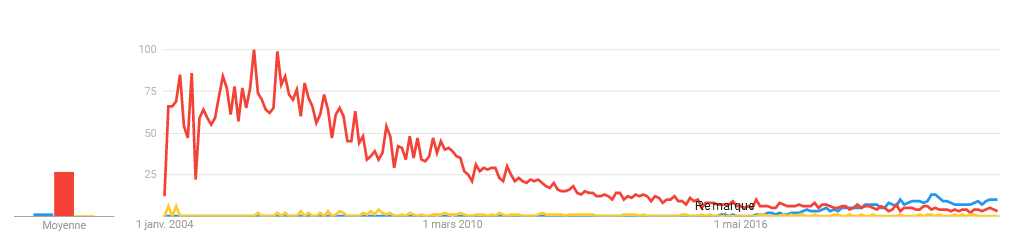
And compared to the terms "open source CMS" (in red) and "hosted CMS" (in yellow):
Comparative graph showing the evolution of interest in the searches for Open-Source CMS, Hosted CMS, or headless CMS 3. The latter gradually surpasses the others.
Generally, content management systems have a "back office," an interface accessible only to the website's creator/owner. From there, they can create and manage the content that appears on the "front end" - the actual website accessible to everyone and found by typing its name into a search engine. The front end incorporates a design that can be built by coding, obtained from a template (in open-source CMS), or configured from the options provided (for hosted CMS).
However, headless CMS is not connected to any specific front end. Only the back office is present. This allows for increased configuration possibilities and unique freedom compared to other CMS. In practice, the same back office for a single site can be configured to display differently on various intended platforms: a website for viewing on a computer, regardless of screen size; Windows and/or Mac applications for computers; websites or applications for smartphones or tablets running on any operating system; applications for smartwatches, and more. Its extreme portability makes it highly attractive and comprehensive despite the lack of a predefined front end. They require advanced computer knowledge and are primarily intended for developers 4.
Finally, they can be categorized as either hosted or open-source. The table below summarizes the main advantages of these new CMS compared to older ones:
| Aspect | Traditional CMS | Headless CMS |
|---|---|---|
| Hosting and delivery | In-house | Cloud-based |
| Security | A traditional web server can be vulnerable to attack. | Separating the back end from the front end isolates some issues, though hosted CMS services can create dependencies. |
| Performance | Performance can require tuning. | The architecture can support good performance. |
| Cost | Many traditional CMS are open source and offer affordable hosting. | A hosted headless CMS can be more expensive. |
| Customisation | Ready-made plugins can address some limitations. | Flexible and easy to customise. |
| Scalability | Adapting a site can be complex. | Content can be distributed across several platforms. |
Source: Flatlogic, “Best Headless CMS” (accessed on 18 November 2021).
| Advantages | Limitations |
|---|---|
| Flexible delivery across channels. | A development team must manage the content infrastructure and delivery interfaces. |
| Separating the publishing environment from the database reduces exposure. | Development has additional costs. |
| Independent front-end and back-end changes make maintenance and customisation more flexible. | Content creators may have fewer built-in features. |
| Teams can test ideas quickly. | Without a preview, marketing teams may find content editing difficult. |
| Developers can choose the languages they work with. |
Source: Flatlogic, “Best Headless CMS” (accessed on 18 November 2021).
2. A brief conclusion on headless CMS
Headless CMS suit developers. For beginners, the technical specialisation can make everyday changes and even light maintenance difficult.
1. Source: BuiltWith, headless CMS usage in France (accessed on 16 November 2021).
2. Source: Google Trends, interest in “Headless CMS” (accessed on 18 November 2021).
3. Source: Google Trends, comparison of the three English search terms (accessed on 18 November 2021).
4. Source: TopHébergeur, headless CMS (accessed on 18 November 2021).
Next chapterStudy conclusion